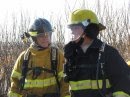
Saturday, July 31, 2010

Thousands Evacuated From California Wildfires Near Los Angeles

PALMDALE, Calif. - Aircraft and about 500 firefighters attacked a river of flame running through grassy hills northeast of Los Angeles Friday as residents of about 1,000 homes waited to see if the blaze is kept away.


Firefighters prepare to attack flames as a fast moving wildfire nears Palmdale, Calif. on Thursday, July 29, 2010. (AP Photo/Dan Steinberg)


Fire engines pause as flames from a fast moving wildfire approach Elizabeth Lake Road in the Leona Valley near Palmdale, Calif. on Thursday, July 29, 2010. Mandatory evacuations were issued for the community of Leona Valley on Thursday evening, Los Angeles County Fire Inspector Matt Levesque said. (AP Photo/Dan Steinberg)

A firefighter looks on as a fast moving wildfire approaches Elizabeth Lake Road in the Leona Valley near Palmdale, Calif. on Thursday, July 29, 2010. Mandatory evacuations were issued for the community of Leona Valley on Thursday evening, Los Angeles County Fire Inspector Matt Levesque said. (AP Photo/Dan Steinberg)

A firefighter dons his gear as a fast moving wildfire burns near Palmdale, Calif. on Thursday, July 29, 2010. (AP Photo/Dan Steinberg)


The wildfire in the Antelope Valley has burned at least three outbuildings, and homes in Leona Valley and Anaverde were still evacuated.

A mandatory evacuation for another 1,000 homes in Rancho Vista was canceled early Friday after the flames stopped at the California Aqueduct, with the concrete channel acting as a natural firebreak on the fire's eastern edge, Los Angeles County fire Inspector Matt Levesque said.

"That fire burned right up to the homes (but there is) no more fuel for it to burn. It's out on that flank," he said.

The fire was about 5 percent surrounded and was expanding north and west, threatening homes in Leona Valley and Anaverde, Levesque said.

About 500 firefighters and aircraft were fighting the blaze, aided by cool, windless morning weather. However, a forecast of gusty afternoon winds and a high of 98 degrees was expected to pose a challenge for crews, Levesque said.

The fire that erupted Thursday afternoon surged through more than 7 square miles of grass and brush, with flames leaping 50 feet at times overnight.

Television reports showed at least two homes burning but Levesque said he could only confirm two buildings and a hay storage facility were destroyed.

A communications repeater and about a dozen power poles were down but no major damage was reported to major electrical transmission lines that crisscross the area, Southern California Edison spokeswoman Cathy Hart said.

"Those lines were de-energized Thursday evening, to reduce danger to firefighters," Hart said. "De-energizing the lines did not cause outages."

The fire broke out north of a state highway that snakes through the San Gabriel Mountains, connecting Los Angeles to the high desert. Angeles National Forest lands lie on either side.

"Man, it looks bad outside. If I step outside the restaurant, it's just insane-looking _ black and orange smoke and helicopters going through, dropping water," said Jamie Karschamroon, 29, the co-owner of Crazy Otto's diner in Leona Valley.

The area is west of the 250-square-mile zone scorched by last summer's Station Fire, the largest wildland blaze in county history.

About 200 firefighters contained another blaze at 350 acres, Levesque said. A third fire was stopped at 30 acres.

Further north in Kern County, good weather helped firefighters build containment lines around two wildfires that destroyed homes in remote mountain communities earlier in the week.

A 2 1/2-square-mile blaze near Tehachapi on the western edge of the Mojave Desert was 46 percent contained after burning about 30 homes and other structures in a scattered community called Old West Ranch.

The community nonetheless remained evacuated, affecting about 150 people, said John Buchanan, spokesman for the California Department of Forestry and Fire Protection.


The blaze erupted Tuesday afternoon and rapidly swept through an area where Kern County fire authorities say there is no history of any fires on record, meaning vegetation hadn't burned there in more than a century.

To the north, a fire that destroyed eight residences and a few outbuildings as it spread across about 26 square miles of the Sequoia National Forest in the Sierra Nevada was 55 percent contained, authorities said.

The cause of the fires is under investigation.

Friday, July 30, 2010

B.C. Wildfire Threatens Homes, Water Drops In The Plan

B.C. wildfire threatens Kamloops homes
Written by The Canadian Press
July 28, 2010, Kamloops, B.C. - Hundreds of homes in Kamloops, B.C., are threatened by a wildfire that broke out Tuesday evening on the edge of the southern Interior city, 350 kilometres northeast of Vancouver.

As many as 150 people have been evacuated from a nearby trailer park on the eastern edge of the city and hundreds more residents living in suburbs around Valleyview, Juniper and Barnhartvale are on evacuation alert.

Kamloops Fire Captain Sheldon Guertin says the blaze has grown to as much as 50 hectares — or half a square kilometre — within hours.

He says firefighters and B.C. Forest Service crews now believe it is 55 per cent contained but several heavily forested ravines lie in the path of the flames.

He says those ravines and many dead standing trees are fuelling the blaze.

No homes have been lost and Guertin says a plan for helicopter water drops or other air support is coming.

California Wildfire Destroys 25 Homes, 150 Threatened

Calif. wildfires burn about 40 homes, threaten 150The fire has grown to 1,230 acres; about 250 firefighters from several different agencies were on the scene, along with water-dropping aircraft

By Raquel Maria Dillon
The Associated Press

TEHACHAPI, Calif. — Hundreds of firefighters gained ground Wednesday against the most destructive of two big wildfires that have burned dozens of homes and forced 2,300 people to evacuate mountain communities on the edge of the Mojave Desert and in the southern Sierra Nevada.

A 1,400-acre blaze that burned 30 to 40 homes in the Old West Ranch community about 10 miles south of Tehachapi was 25 percent contained, the Kern County Fire Department said. Some 150 homes in the loosely connected community remained threatened.

The area is usually so gusty that wind farms line ridges, but early Wednesday afternoon the weather was cooperating with the 800 firefighters on the lines, producing only light breezes.

At a Red Cross evacuation center in Tehachapi, Sarah DeSmet, 22, of Los Angeles cuddled a dusty black kitten she had pulled out of the rubble at the home of her uncle, George Plesko, who looked dazed as volunteers tried to get him to eat lunch.

"My uncle called my mom to say his final goodbyes" because he didn't think he would get out alive, DeSmet said.

Part of the fire in the eastern foothills of the Tehachapi Mountains, about 70 miles north of Los Angeles, was sending up a large plume of smoke, while other areas only smoldered.

About 40 miles to the north, a fire that began Monday in Sequoia National Forest grew to 15,600 acres, or about 24 square miles, and was only 5 percent surrounded after burning eight homes and six outbuildings in the area of Kernville, a launching point for mountain adventuring. No other homes were in immediate danger.

Officials were investigating what caused the fires.

The fire in Old West Ranch broke out Tuesday and carved a path of destruction. At one site, a house had collapsed upon itself. At another property, only a singed wooden bannister was left standing.

Lane Butchko, a retired resident without a car, recounted desperately fleeing a half-mile down a mountain road before a motorist picked him up.

"I grabbed my dog and we ran for our lives. I forgot my teeth," he said. "We were going at a full gallop and halfway down I fell, tripped on the dog's leash. When I got up, I felt the heat of the fire on my back and I saw a tree burst into flames."

Years of drought in the Tehachapi area, along with tree diseases and bugs among the foothills' pine and chaparral, have turned the area into a "tinderbox," said county fire Battalion Chief David Goodell.

Peggy Pingry, who has lived in Old West Ranch for 25 years with her husband, said people are drawn to the remote area by the solitude, freedom to do what they like on their property, and the wildlife.

"Nobody up there is rich, well, maybe one person. Everyone's retired or working, with some people on limited incomes," she said. "They're all self-sufficient and happy to be alone and off the grid."

In the parking lot of the evacuation center, Robert Tipton, 67, tried to soothe his dog, Poppy, who barked and whined inside a metal crate.

"It's OK, girl, you're all right now," he said.

Tipton said Poppy's barking was his first warning of the fire Tuesday afternoon.

He then saw black smoke coming toward his rented home on Summers Drive.

"The next thing I knew, the fire department was up there and I was on the way down the hill towards town, hoping to pick up my things later," he said. "I found out last night that we've lost all our property," he said. "I don't know what to say. It's going to be heard, but we'll survive all this."

Gov. Arnold Schwarzenegger declared a state of emergency for Kern County on Tuesday, freeing up state resources to battle the fires.

Meanwhile, firefighters made progress early Wednesday against the largest of more than 150 lighting-sparked fires in northeastern California. The 250-acre blaze east of Straylor Lake in the Lassen National Forest was expected to be fully contained by the end of the day, said Daniel Berlant, a spokesman with the California Department of Forestry and Fire Protection.

An additional 187 fires were burning in other remote parts of Lassen County and in Plumas, Siskiyou, Shasta and Modoc counties. Most were less than an acre and were contained.


The Next Day

TEHACHAPI, Calif. - Calm, cool weather Thursday morning dampened a wildfire that destroyed 25 buildings north of Los Angeles, and crews were prepared for afternoon winds that could kick up the flames again, a fire spokesman said.

A structure near Blackburn Canyon Rd and Gary Road in the foothills above Tehachapi, Calif., burns Tuesday July 21, 2010 after two wildfires erupted and spread quickly. More than 30 homes were lost in the small hill community of Old West Ranch and another 150 structures were threatened, firefighters said Tuesday. The area is about 70 miles north of Los Angeles. (AP Photo/Dave Mills)

A home, bottom center, is threatened by a wildfire that erupted Tuesday July 27, 2010 and spread quickly near Tehachapi Calif. More than 30 homes were lost in the small hill community of Old West Ranch and another 150 structures were threatened, firefighters said Tuesday. The area is about 70 miles north of Los Angeles. (AP Photo/Mike Meadows)

A huge column of smoke from the West Fire can be seen from the highway near the city of Tehachapi, Calif., from 50 miles away in photo taken west bound on highway 58. About 30 to 40 homes have been lost to the wildfire. Officials said 150 structures were threatened and about 200 firefighters were on the scene, along with waterdropping aircraft. (AP Photo/Mike Meadows.)

An inmate crew marches to the fire at Old West Ranch were residents were evacuated due to a wildfire about 10 miles southeast of the Mojave Desert town of Tehachapi, Calif., Wednesday, July 28, 2010. Firefighters on Wednesday braced for strong afternoon winds at the sites of two wildfires north of Los Angeles that have burned about 40 homes, threatened at least 150 more and forced some 2,300 people to evacuate. The two blazes in mostly rural Kern County remained out of control after scorching more than 26 square miles (67 square kilometers) of hilly pine forests and chaparral. (AP Photo by Alex Gallardo)

Fire helicopters work at Old West Ranch were residents were evacuated due to a wildfire about 10 miles southeast of the Mojave Desert town of Tehachapi, Calif., Wednesday, July 28, 2010. Firefighters on Wednesday braced for strong afternoon winds at the sites of two wildfires north of Los Angeles that have burned about 40 homes, threatened at least 150 more and forced some 2,300 people to evacuate. The two blazes in mostly rural Kern County remained out of control after scorching more than 26 square miles (67 square kilometers) of hilly pine forests and chaparral. (AP Photo by Alex Gallardo)


The 1,436-acre blaze still threatened about 150 homes, but was 25 percent contained. If the weather cooperates, the fire should be fully surrounded by Friday, said California Department of Forestry and Fire Protection spokesman John Buchanan.

A pattern of cool, moist morning and evening air was helping as nearly 800 firefighters carved firelines in the eastern foothills of the Tehachapi Mountains, about 70 miles north of Los Angeles.

"I don't even see smoke," Buchanan said Thursday morning. "I was out there. ... All you saw was glowing embers."

The temperature was expected to hit 92 and winds were expected to jump in the afternoon to 14 mph, Buchanan said.

On Wednesday afternoon, a few afternoon gusts pushed the fire into action on its eastern side and swept unburned islands of brush into flame.

"It did make some pretty intense moments," but firefighters anticipated the wind change and dealt with it, Buchanan said.

The area is usually gusty and wind farms line ridges, but overall winds were light on Wednesday.

About 40 miles to the north, a fire that began Monday in Sequoia National Forest grew to 15,982 acres, or about 24 square miles, and was 12 percent surrounded after burning eight homes and six outbuildings in the area of Kernville, a launching point for mountain adventuring.

About 1,200 homes and structures scattered in the fire area were considered threatened, but Bureau of Land Management information officer Michelle Puckett said they were not in immediate danger.

Rafting companies, which normally take vacationers on trips down the Kern River, were being used to ferry firefighters to parts of the blaze that were otherwise inaccessible, Puckett said.

The causes of both fires were under investigation. The fire near Old West Ranch broke out on Tuesday.

The firefighting command revised the number of destroyed structures down to 25, and Kern County Fire Department Battalion Chief Dean Boller said most were homes.

On Wednesday, Barbara Grantham was handing out doughnuts, lemonade, iced tea and cold water to anyone who passed by her driveway in Blackburn Canyon near Tehachapi.

She said her family's $25,000 solar power system survived as well as her home, but a couple storage structures and tool sheds were lost to the fire. "With our faith we understand that those are temporary things, but I did save a photo of my mom," she said.

When she and her husband bought the property in 1992 they didn't know about the fire danger, she said. The price was right but they put in thousands of dollars of improvements _ a pump on the well, a couple of outbuildings and the solar power system.

"You can't get fire insurance here. It's a high fire threat area. If you can get it, it's pricey and doesn't cover the fire," she said.

At a Red Cross evacuation center in Tehachapi, Sarah DeSmet, 22, of Los Angeles cuddled a dusty black kitten she had pulled out of the rubble at the home of her uncle, George Plesko, who looked dazed as volunteers tried to get him to eat lunch.

"My uncle called my mom to say his final goodbyes" because he didn't think he would get out alive, DeSmet said.

Tuesday, July 27, 2010

Chief and Firefighter Killed In Enroute To Call

Two firefighters, including Fire Chief Posey Dillon, were killed when a Rocky Mount fire truck on its way to a house fire crashed into an SUV, flipped several times and landed on a car, state police, the town's mayor and a witness said.

Fire Chief and Vice Mayor Posey Dillon, along with firefighter William Daniel "Danny" Altice died in the wreck, according to Virginia State Police Sgt. Michael Bailey.

A Rocky Mount fire truck was eastbound on Old Franklin Turnpike in Rocky Mount when a Ford Escape coming from School Board Road entered intersection of the two roads and struck the engine, according to Bailey. The fire truck, responding to a blaze in Union Hall, swerved and flipped at least three times, Bailey said.

Bailey believed the weight of the truck, loaded with 1,000 gallons of water, shifted during the crash. The fire truck landed on its last flip on a blue Ford Mustang, which had been traveling westbound on Old Franklin Turnpike.

One person was removed from the fire truck and taken by helicopter to a hospital, said Wanda Bailey, a manager at the nearby Sheetz convenience store on Old Franklin Turnpike near Route 220 in Rocky Mount. Another person was pinned under the truck, she said.

At least two people from the wreck were transported to Carilion Franklin Memorial Hospital, according to Carilion spokeswoman Allie Buth. One person died on the way to or at the hospital, she said, and another was listed in stable condition. Buth declined to identify either person.

Buth was not sure if anyone had been airlifted from the scene.

"We lost two dedicated public servants in that accident," said Rocky Mount Mayor Steve Angle, confirming that two firefighters died in the collision. "Both were well-known and respected men in the community. It's a devastating blow to Rocky Mount." He would not name the firefighters who died, but said they were the only two on the truck.

It was not immediately clear how seriously the drivers of the Explorer and Mustang were injured, if at all.

"It's terrible. It's really, really bad," Wanda Bailey said. "Most of these firefighters come in here every day. It's kind of heartbreaking to us. We know them. They're basically like family."

"I heard a great big crash and we came outside," said Christy McKinney, 35, of Rocky Mount, an employee of Mattress Depot across the street from the wreck.

The intersection of Old Franklin Turnpike and Route 220 is blocked off while officials investigate, according to the Virginia Department of Transportation.

Copyright The Roanoke Times, Reprinted with Permission, July 26th, 2010.

More Details, Men Were Veterans of Virginia Department

Information Courtesy The Franklin News Post - FNP Slideshow

Rocky Mount Fire Chief and Vice Mayor Posey Dillon and longtime fireman William D. "Danny" Altice were killed today in an accident in Rocky Mount involving a town fire truck and two automobiles.

According to Virginia State Police First Sgt. Mike Bailey, the fire truck was dispatched to a structure fire in Union Hall and was traveling east through the intersection of Rt. 40 East and School Board Road (in front of Sheetz) when a car pulled out from School Board Road into the intersection.

The car, a Ford Escape, reportedly hit the rear of the fire truck, which then hit the curb on the other side of the road and flipped, landing on top of another car, a Mustang.

Dillon and Altice, who were the only occupants of the fire truck, were both thrown from the truck, Bailey said.

Dillon had served on town council for 24 years, including 10 years as vice mayor, and was re-elected vice mayor by council earlier this month. He had been fire chief for 20 years.

Altice joined the fire department in 1963 and served as chief from 1977 to 1984. He was presented a lifetime achievement award by town council in 2008.


Posey Dillon (right) is pictured above with Danny Altice during a ceremony in February 2008 when Altice was presented a lifetime achievement award by the Rocky Mount Town Council. They were killed Tuesday afternoon in a collision with a car while responding to a call.


My Opinion

This is just one more saddening case of what can happen to any of us enroute to a call, returning from a call, or even for those volunteers/paid on-call firefighters that are responding to the hall. We have to be careful driving at all times, including when the adrenaline is pumping and we're responding to a call. The flashing lights and the loud siren don't give us the right of way, and we have to remember that. We're only asking for the right of way. If we assume it's given to us, then accidents can and will happen. This includes, clearing an intersection, rate of closure, following distances, and improper use of lights and sirens. I'm extremely sad and sorry to hear something like this happened, and I am not in any way saying that this was their fault, but we can learn from this and realize that not everyone sees us or will yield the right of way. We have to start taking defensive steps in driving and assume that the driver WON'T stop for us so we can plan ahead and take the precautionary measures while still getting to the scene in a reasonable amount of time. Make eye contact, make sure they've stopped and KNOW you're there and what your intentions are and then proceed. It doesn't take long to do. Remember, to do your job at the scene, you have to make it there. Everyone home safe, everyday.

Brad MacMillan

SUV Crashes Into Fire House In Delton, WI

Driver crashes into fire department in Wis.Fire Chief Andy L. Schultz said the vehicle crashed into the station's bay doors

DELTON, Wis. — Delton fire officials didn't have to travel far to investigate after an SUV slammed into a building because the driver crashed into the fire department itself.

The crash occurred about 6:30 a.m. Saturday. The only injury was to the driver, who was airlifted to a hospital. Her condition was not immediately known.

Fire Chief Andy L. Schultz said the vehicle crashed into the station's bay doors. He told WMTV-TV the building sustained heavy structural damage, but none of the equipment was affected.

Friday, July 23, 2010

Man Dies, Firefighter Critical In Crash En Route To Call

Portage Fire District volunteer firefighter Timothy Johnson was en route to a fire that engulfed a bowling alley when the crash occurred

By Vince Guerrieri
The Port Clinton News Herald

SALEM TOWNSHIP, Ohio — An Elmore man is dead and a volunteer firefighter was in critical condition after a car accident Friday night.

Ian Hoffman, 24, of Rice Street, was killed in the accident.

Timothy Johnson, 41, a volunteer firefighter for the Portage Fire District, was taken to Magruder Hospital and then transported by LifeFlight to Medical University of Ohio, where he remained in critical condition Saturday. Johnson was driving his own truck, but was headed to a fire at Clay Center Recreation. There was no information available Sunday on his condition.

Hoffman was a passenger in a 1999 Mazda Protege driven by Olivia Duty, 20, of Woodville, traveling west on Oak Harbor South East Road around 11 p.m. Friday. Duty stopped for the stop sign at Ohio 19 and pulled into the intersection, traveling northbound, and then tried to turn west onto Portage River South Road.

Johnson was traveling north on Ohio 19 in his 2004 GMC Sierra truck. Ottawa County had requested help from any available firefighters to keep the blaze — which engulfed Clay Center Recreation — from spreading.

The first firefighters, from Allen-Clay Joint Fire District, were called to the bowling alley at 10:18 p.m. The business closed early, around 9:30, so nobody was in the building when the fire started.

By the time firefighters got there, the building was fully ablaze.

"There was fire from front to back," Deputy Chief Denny Hartman said. "It was really cooking. We weren't going to stop the fire."

While he was en route to the fire, Johnson's pickup struck the left rear of Duty's car, which went off the road and into a field. Johnson's truck went off the road and hit a tree.

Johnson was not wearing a seat belt, but his air bag did deploy. The air bags in Duty's car did not deploy. Hoffman wasn't wearing a seat belt. It is unknown if Duty, who was taken by Life Flight to MUO, was wearing a seat belt. She was listed in stable condition Saturday, but no information was available Sunday.

No charges have been filed. The Sandusky Post of the Ohio Highway Patrol is investigating, and don't believe alcohol was a factor in the crash.

The Ohio Highway Patrol was assisted at the scene by officers from the Ottawa County Sheriff's Department, Mid County EMS, Portage District Fire Department, Toledo St. Vincent Life Flight and Terry's Towing.

The State Fire Marshal's Office and Allen-Clay Joint Fire District are investigating the cause of the fire. Hartman couldn't put a monetary figure on the damage, but said the building was a total loss.

My Opinion

Here is yet another case of improperly clearing an intersection, excessive speed, failure to use safety devices and poor judgement. To clear an intersection, whether it's green or not, you're still supposed to slow down, not to mention, he was in his personal vehicle which he shouldn't be speeding. Neither man was wearing a seat belt which both should have been. Airbags are directional for the most part, so they may or may not go off if struck on the left side as the airbags are most likely just the front impact ones, so they probably wouldn't go off. Which is just one more reason why the man was killed. Johnson was lucky to have his airbags go off. In any case, using better judgement, less speed and proper protocols would help to prevent these situations. My condolences to the Hoffman family and a quick speedy recovery from Hoffman. Lessons learned I hope and maybe we can prevent this situation from happening.


Firefighter Brad MacMillan

Washington Wildfire Claims Engine But Firefighters Survive

Audio
Radio Traffic of WV-31 overrun by a grass fire

YAKIMA, Wash. - From his rear seat on Engine 31, Michael Rhine watched the fire, seemingly at a safe distance. But as the engineer swung the truck around to face the one way out, a big stand of sagebrush blew up into a 40-foot wall of flame. Amid zero visibility and intense heat, Engine 31 was engulfed, crashing through a dirt barrier and a barbed-wire fence before faltering to a stop.

"They're off the road," someone yelled on the radio. "Probably need a mayday."

The two firefighters in front bailed out the driver's door, but Rhine couldn't budge the back door. It was so hot his hand blistered as he tried to push it open.

The others yelled at him to go out the front, but he couldn't hear over the roar of the fire. He dove over the seat, out the door and to the ground, and they began to flee. As the three sprinted across a field in search of safety, Rhine felt the fire burning his ears. He kept running.

The wildfire that broke out Sunday west of downtown Yakima, an agricultural hub known for tree fruit, wine grapes and hops for beer, burned across nearly 10 square miles before firefighters contained it. The blaze destroyed a vacant home, a vacant structure owned by the state and four outbuildings. Fences, pump houses and fruit trees were damaged.

Also lost: Engine 31, a structure protection fire truck valued at $400,000.

The three firefighters on board suffered minor injuries. But their narrow escape illustrates the dangers of fighting wildfire in the arid West, where tinder-dry land and blustery winds can almost instantly turn a routine blaze into a killer.

Rhine took up volunteer firefighting some two years ago, initially to bond with his son. When the son pursued other interests, the father found he enjoyed it and continued training.

Rhine relishes the volunteer work that fills his summers. The 50-year-old school counselor said it makes him feel as if he's "going on 35."

The 2010 fire season started quietly here with a wet spring, though recent temperatures well into the 90s dried the grasslands and forest floors out quickly.

Blue skies and sunshine greeted Rhine Sunday, so he spent the day riding his motorcycle. He noticed the plume of smoke drifting from behind a ridge just after 2 p.m. while riding home.

Rhine stopped in at the station. No calls yet. But he went home, put on his firefighting pants and shirt and gathered his gear. Then the call came.

Mike Willette spent the afternoon touching up the paint on his new horse barn, monitoring the smoke from his home atop a bluff at the end of a narrow, dead-end driveway.

A neighbor hollered over from his orchard: "Michael, you keeping an eye on that smoke? I lived through this as a kid, and you can't run fast enough."

When Willette saw the fire reach the bottom of the hill, he told his wife, Suzan, time to go.

She gathered photos and other keepsakes, and Mike Willette scattered sprinklers to protect the house. His wife drove away in one car. He followed in another, stopping briefly to halter their two horses and release them.

Engine 31 entered the driveway as Mike Willette pulled away.

"I'm sending 31 down there. We do need to protect the egress. They have one way in, one way out," a lookout said.

"Copy. If we have to get people outta there, get 'em moving," a command voice replied. "Hey, no heroics. You know, we don't want anybody to get hurt."

Rhine surveyed unburned fields as the truck picked its way over the bumpy dirt lane toward the house and Engine 45, a water truck already in place. He didn't see any signs of immediate danger. His driver began to turn the 30-foot fire truck around at the end to beat a hasty retreat if need be.

Routine chatter continued over the radio for a few minutes before a voice bursts in: "Three-one, get out. Get out."

Rhine felt the heat, the smoke getting thicker.

Another voice, much more urgently, seconds later: "It's heading west. Get 31 outta there!"

Yakima has been scarred by wildfire before. In 2001, four area firefighters died battling the Thirtymile fire in north-central Washington's Okanogan National Forest. An investigation found that fire bosses had broken all 10 U.S. Forest Service standard safety rules and ignored numerous signs of danger.

This week, Rhine and the two other firefighters sprinted across a field and found safety beyond Willette's barn. Another truck swooped in to pick them up and an ambulance carried them to a hospital.

Over the radio: "Lost the damn truck, but everybody's accounted for."

Injuries were minor: a twisted ankle, smoke inhalation and cuts. Rhine suffered second-degree burns to his ears.

Safety was the top priority Sunday, Rhine said. He said he doesn't believe any safety rules were broken. Quite simply, fire is erratic.

"We went into a situation that was deemed safe. We knew there was some risk, but the fire behavior changed within seconds," he said.

Rhine still considers himself a rookie, despite many hours of training. His two colleagues on the truck had several years of experience. Both have declined comment. West Valley Fire and Rescue officials also declined to discuss the incident during the third-party investigation.

"I remember thinking I was going to die," Rhine said, but added that getting stuck in the cab of a burning truck wasn't a defining moment in his life.

"The care and compassion I received from brother and sister firefighters afterward was the defining moment to me," he said. "Living through it and experiencing the love and support from fellow firefighters and others in my life."

Mike Willette's house survived the fire. His new barn did not.

"I'm so glad they're alive," he said.

My Opinion

So, I'm not only a volunteer firefighter, but I'm also a wildland firefighter with Alberta Sustainable Resource and Development in the Waterways (Ft. McMurray) District. So I've seen my fair share of wildland fires and I can tell you that fire IS very erratic. But with that being said, you have to know your topography, area, and weather to fight fire effectively.

I know that when I see a storm cloud (CB) moving in, that it's going to change the winds as it passes over or around. I know that the downdrafts off that CB can affect the winds over 16km's away. You also have to take into account, topography, slope, terrain, vegetation, and moisture in the air. If it was a hot day and they know that the Relative Humidity (RH) was going down to the lower percentile (ie 15-25%) then they may experience cross-over conditions where you're more likely to see extreme fire conditions. Especially seeing that the temperatures were in the 90F range (32C). You should EXPECT to see extreme and erratic behaviour and sometimes, the best thing to do is to take a step back and re-assess the situation. Maybe you need to burn out ahead of the fire? Maybe you need more resources like air tankers, heli-bombers, and ground resources. Great job in containing the fire, and although they lost the engine, it's fantastic (even a miracle) that everyone was safe and not seriously hurt.

The vegetation they have down there is very similar to a grass fire in that it can seem pretty benign and an easy catch, then you get that shift in wind and the fire goes from heading towards a natural fuel break such as a road where it'll most likely stop and you can hold it, to continuous fuels and it builds heat, energy, and momentum there. All of a sudden you're short resources, and you're stretching thin and you may not know it. Safety HAS to be of the utmost importance. Yes we're here to do a job, and yes saving property is one of those jobs, but saving lives, including our own, is said first for a reason. Protect yourself and be careful of watch out situations like this one. I'm glad they're all ok, but let's try to learn from this incident. It's not a mistake because things like this do happen just because they do and fire is like that, but if we can learn from this, it might help us plan for that scenario and maybe cope with it a little better. Maybe you DON'T go down that one way road and have a separate egress point? Maybe you choose a LARGE safety zone that WON'T burn over. These are things that we can think of.

Firefighter Brad MacMillan